India is one of the world’s largest producers of agricultural commodities and a global leader in milk, pulses, spices, fruits, and vegetables. According to the Ministry of Food Processing Industries, the food processing sector contributes around 7.93% of India’s manufacturing GVA, while providing employment to more than 7 million people.
The industry is expected to reach ₹45.8 lakh crore by FY26. This growth is driven by rising domestic consumption, exports, government incentives, and increasing investment in food processing infrastructure.
Punjab, Karnataka, Madhya Pradesh, Gujarat, Chhattisgarh, Uttar Pradesh, Haryana, West Bengal, Assam, and Andhra Pradesh are the top states in India for crop production.
The food industry consumes approximately 30% of global energy. Using solar for the agro industry is one of the best and most cost-effective power solutions that can help meet the huge energy requirement.
An on-grid rooftop solar system is an ideal solution for agro and food processing industries due to their high and continuous electricity consumption.
It generates electricity during the day to power processing equipment, refrigeration systems, cold storage units, and packaging machines, which reduces dependence on expensive grid electricity.
Since on-grid systems do not require battery storage, they have lower installation and maintenance costs than off-grid or hybrid systems. Businesses can also benefit from net metering or net billing, where applicable, by exporting surplus electricity to the grid.
This helps lower operational expenses, improve energy efficiency, and achieve a faster return on investment.
Here are some top advantages of choosing solar energy for the food processing industry:
Among other renewable energy sources, solar energy has a shorter payback period, where you can get your initial money back just after 3-5 years. After that, you will enjoy free electricity for more than 25 years.
Using solar solutions for your food processing factory, you can save up to 70-80% of your monthly electricity bills. These savings will help you with the overall profitability of your business.
Unlike fossil fuels, solar energy is more reliable as it is available everywhere. Additionally, the solar system for an agro company needs a very minimal annual maintenance cost that is just 1-2% of the initial cost.
Replacement of thermal or non-renewable energy with solar power helps in carbon and greenhouse gas emission reduction. Solar energy generation has zero harmful effects on the environment.
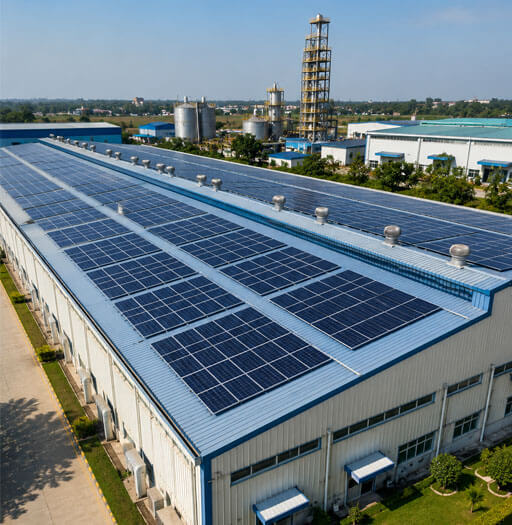
An on-grid rooftop solar system is an ideal solution for agro and food processing industries due to their high and continuous electricity consumption.
It generates electricity during the day to power processing equipment, refrigeration systems, cold storage units, and packaging machines, which reduces dependence on expensive grid electricity.
Since on-grid systems do not require battery storage, they have lower installation and maintenance costs than off-grid or hybrid systems. Businesses can also benefit from net metering or net billing, where applicable, by exporting surplus electricity to the grid.
This helps lower operational expenses, improve energy efficiency, and achieve a faster return on investment.
Here is the table about the energy consumption by an agro and food processing factory for different processes:
| Process | Energy Consumption (MJ/kg) |
| Drying | 0.5 – 0.75 |
| Storage | 1 – 3 |
| Food and Beverage Processing | 50 – 100 |
| Cooking | 5 – 7 |
| Evaporation | 2.5 – 2.7 |
To fulfil this energy requirement, the factories usually use thermal electricity or alternative non-renewable energy sources. You can choose solar energy to fulfil this energy requirement.
Follow this table to get an idea of your savings after solar installation for the agro industry:
| Solar System Size | Monthly Generation | Monthly Savings |
| 150 kW | 22,500 unit | ₹2,70,000 |
| 375 kW | 56,250 unit | ₹6,75,000 |
| 500 kW | 75,000 unit | ₹9,00,000 |
Note: Electricity generation and monthly savings are approximate values. Actual generation depends on project location, solar irradiation, system efficiency, and electricity tariff.
The machines used in the agro and food processing factory vary according to the food being prepared. These are some common types of machinery used in an agro & food processing factory:
| Machine Type | Machine Name |
| Preparation Equipment | Ultrasonic cleaner, air classifier, magnetic separators, vision sorting system, steriliser, spray washer. |
| Mechanical Processing Equipment | Attrition mills, emulsifiers, homogenisers, meat grinders, mixers, roll crushers, single or twin-screw extruders, band saws. |
| Heat Processing Equipment | Ovens, pasteurisers, fryers, dryers, and roasters. |
| Preservation Equipment | Refrigerators, irradiation equipment, cryogenic systems. |
| Packaging Equipment | Case packing machines, cartooning. machines, weighing machines, pick and place robots, food cutting robots, form-fill-seal machines |
| Material Handling and Storage Equipment | Automatic guided vehicles (AVGs), bucket elevators, conveyor systems, flat belts, industrial trucks, mezzanines. |
These are the steps of how the agro and food processing industries work:
The cost of agro industry solar installation depends on multiple factors such as installation location, type of solar system, structure of your factory, etc. Additionally, the cost may increase if you add any customisations to your solar system.
To know the exact cost, please reach us at 9830795307 or email us at [email protected]. We will discuss this with you and arrange a site visit with our eligible installation partner. After that, you will get the cost details as soon as possible through the solar quotation.
Our installation partners will check your requirements and send you quotations within 48h hours.
Your site visit will be scheduled at the provided location. The team will connect for a better experience.