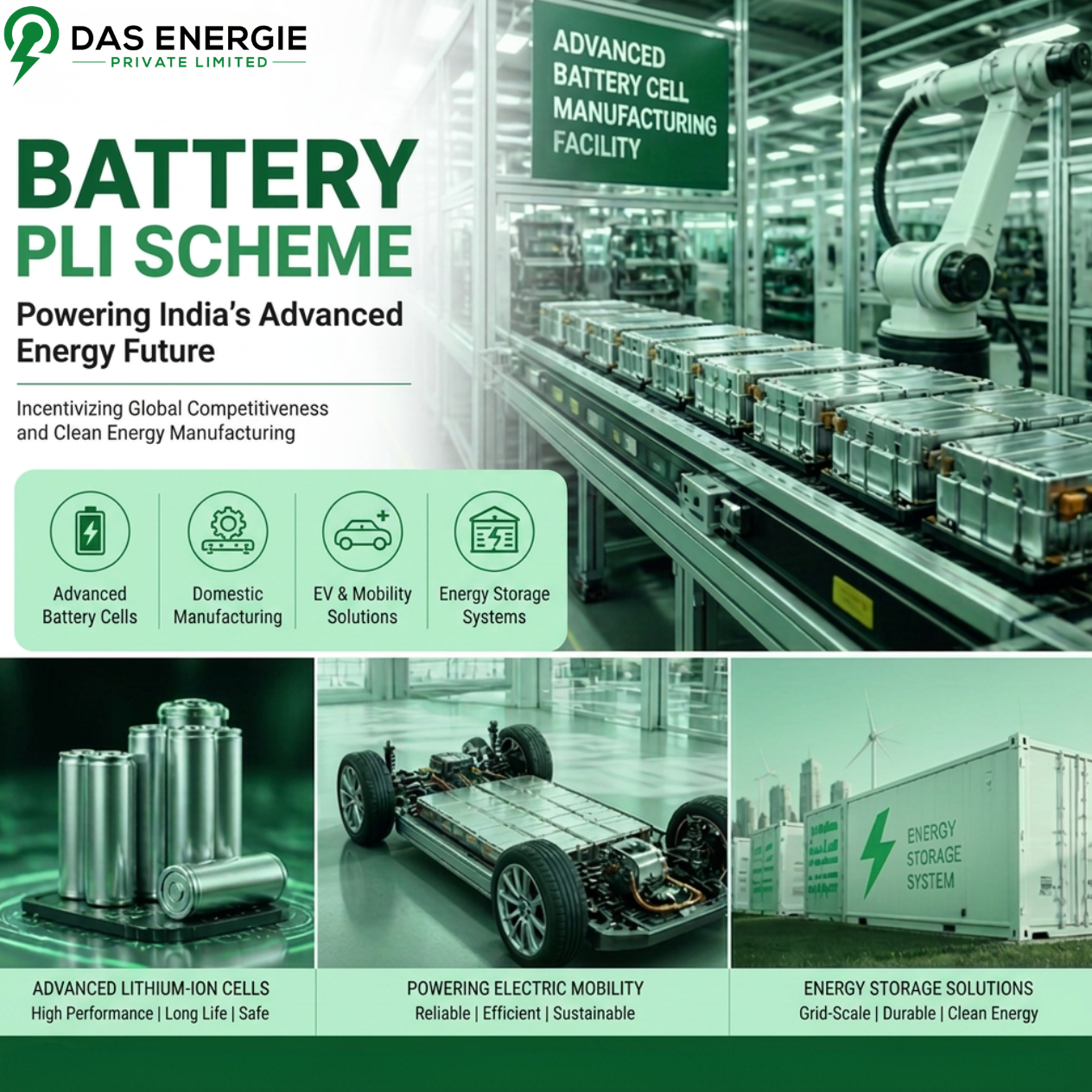
India has revised the Battery PLI Scheme to make participation easier for manufacturers while reducing incentive rates, signalling a shift towards attracting more realistic investments in domestic battery production. The policy update comes as the government revealed that no incentives have yet been claimed under the Advanced Chemistry Cell (ACC) programme despite investments crossing Rs. 5,180 crore.
The Ministry of Heavy Industries has relaxed certain eligibility and performance conditions under the ACC-linked incentive programme while lowering subsidy rates. The revised approach aims to encourage wider participation in Battery Manufacturing India as the country prepares for rising demand from electric vehicles and grid-scale energy storage.
The ACC PLI Scheme India, approved in May 2021 with a budgetary outlay of Rs. 18,100 crore, targets 50 GWh of domestic battery manufacturing capacity. According to the latest government data, 40 GWh has already been allocated across four projects. These include Ola Cell Technologies Pvt. Ltd. (20 GWh) in Tamil Nadu, ACC Energy Storage Pvt. Ltd. (5 GWh) in Karnataka, and two Reliance New Energy entities with a combined 15 GWh in Gujarat.
However, Minister of State for Heavy Industries Shri Bhupathiraju Srinivasa Varma, in a written reply in the Lok Sabha on 21 July 2026, confirmed that no beneficiary has claimed incentives under the ACC PLI Scheme so far. As of 31 May 2026, participating companies had invested Rs. 5,180 crore and created 1,277 direct jobs. Earlier government data also indicated that only 1 GWh of manufacturing capacity had been commissioned by Ola Cell Technologies, while the remaining projects are still under development.
The government believes the revised Battery Subsidy framework will improve participation by reducing compliance barriers for manufacturers. While companies will receive lower financial support per unit produced, the relaxed norms are expected to make the scheme more practical for investors facing high capital costs, technology risks, and volatile raw material prices.
The policy change also reflects India’s broader Energy Storage Policy goals. Domestic battery production is considered essential for reducing import dependence, strengthening supply chains for electric vehicles, and supporting renewable energy integration through large-scale storage systems.
The latest announcement follows strong progress under the government’s automobile PLI programme. Since its launch in September 2021, the auto scheme has attracted Rs. 44,326 crore in investments, generated 67,820 jobs, and disbursed Rs. 2,386.36 crore in incentives across 225 manufacturing units nationwide.
Industry observers will now closely watch whether the revised Battery PLI Scheme leads to faster project commissioning, fresh investment announcements, and commercial-scale battery production over the coming months.
Loading next article...
Our installation partners will check your requirements and send you quotations within 48h hours.
Your site visit will be scheduled at the provided location. The team will connect for a better experience.