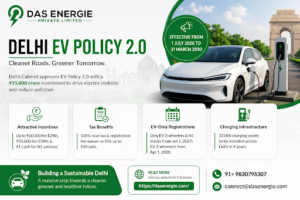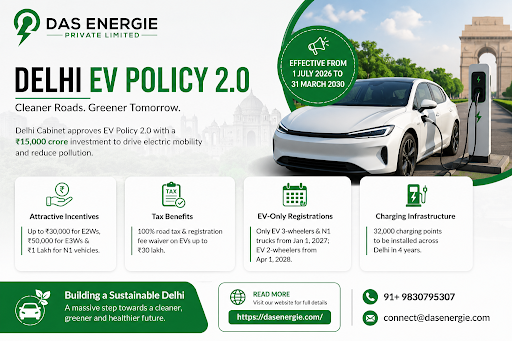
Delhi has approved the Delhi EV Policy 2.0, marking one of India’s most ambitious electric mobility programmes. Effective from 1 July 2026 until 31 March 2030, the policy combines purchase incentives, tax exemptions, scrappage benefits and phased restrictions on new internal combustion engine (ICE) vehicle registrations to accelerate the city’s transition towards cleaner transport.
Chief Minister Rekha Gupta announced that around Rs. 15,000 crore will be invested over the next four years to support electric mobility and reduce vehicular emissions across the National Capital Region.
Under Delhi EV Policy 2.0, electric cars priced up to Rs. 30 lakh (ex-showroom) will receive a 100% exemption from road tax and registration fees, while vehicles above this threshold will not qualify for these benefits.
The policy also introduces time-bound purchase incentives to encourage early adoption. Buyers of eligible electric two-wheelers will receive subsidies of up to Rs. 30,000 in the first year, Rs. 20,000 in the second year, and Rs. 10,000 in the third year.
Electric three-wheelers will qualify for incentives of Rs. 50,000, Rs. 40,000, and Rs. 30,000 over the same period, while N1 electric light commercial vehicles will receive subsidies of up to Rs. 1 lakh in the first year.
The Delhi electric vehicle policy sets clear deadlines for electrification across major vehicle categories. From 1 January 2027, only electric three-wheelers and N1 goods carriers will be eligible for new registration.
Registration of new ICE-powered two-wheelers will end from 1 April 2028, although existing registered vehicles can continue operating throughout their permitted lifespan.
To support this transition, the Delhi government plans to establish 32,000 public charging points over the next four years through state funding and the PM e-Drive scheme. Delhi Transco Limited has been designated as the nodal agency for developing charging and battery-swapping infrastructure, while a dedicated online portal will process applications for Delhi EV subsidies.
The policy also offers financial support for replacing older vehicles with electric alternatives. Owners scrapping eligible BS-IV or older vehicles can receive incentives of Rs. 10,000 for two-wheelers, Rs. 25,000 for three-wheelers, Rs. 50,000 for N1 trucks, and Rs. 1 lakh for eligible private cars when switching to an EV within the prescribed timeline.
School operators must convert at least 10% of their bus fleets to electric within two years, with higher adoption targets planned by 2030.
The policy has received mixed reactions from the automotive industry. The Society of Indian Automobile Manufacturers (SIAM) argued that policy measures should prioritise replacing older polluting vehicles instead of restricting registration of modern BS-VI two-wheelers, stating that ICE two-wheelers contribute a relatively small share of PM2.5 emissions.
Tarun Mehta, Co-founder and CEO of Ather Energy, added that the combination of financial incentives, phased electrification mandates and charging infrastructure provides a strong foundation for faster EV adoption in Delhi.
Loading next article...
Our installation partners will check your requirements and send you quotations within 48h hours.
Your site visit will be scheduled at the provided location. The team will connect for a better experience.