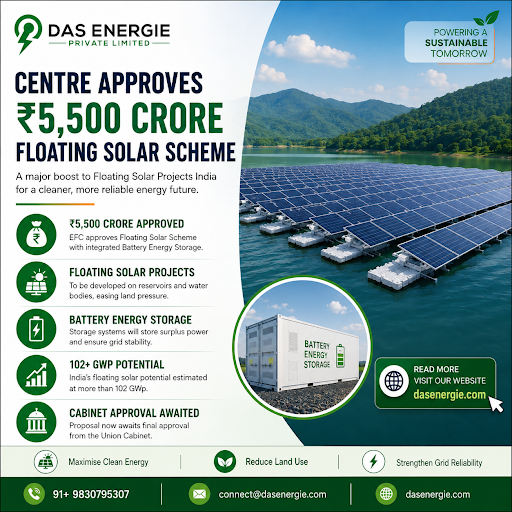
Floating Solar Projects India received a significant policy boost after the Finance Ministry’s Expenditure Finance Committee (EFC) approved a Rs. 5,500 crore Floating Solar Scheme integrated with Battery Energy Storage systems. The proposal, which now awaits Union Cabinet approval, aims to expand renewable energy capacity, reduce land constraints, and improve grid reliability through large-scale Solar Storage Projects.
The Ministry of New and Renewable Energy (MNRE) had originally proposed an allocation of Rs. 6,700 crore for the programme. However, the EFC approved a revised outlay of Rs. 5,500 crore and recommended modifications to the incentive structure before forwarding the proposal to the Union Cabinet.
The Floating Solar Scheme supports the government’s strategy of expanding renewable energy beyond conventional ground-mounted projects. Floating solar plants reduce pressure on land resources, improve solar module efficiency through natural cooling, and help minimise water evaporation from reservoirs.
On 10 June 2026, Union Minister for New and Renewable Energy Shri Pralhad Joshi released the Floating Solar PV Potential Assessment Report, which estimates India’s floating solar potential at more than 102 GWp, taking the country’s total assessed solar potential to 3,445 GWp. He also confirmed that the Ministry is working on a dedicated Floating Solar Scheme to accelerate deployment across the country.
Speaking at the event, Shri Pralhad Joshi said, “Reservoirs and other water bodies are emerging as important assets for clean energy generation through floating solar projects. These initiatives reflect the Government’s commitment to harnessing natural resources in a sustainable and efficient manner while accelerating India’s clean energy transition.”
MNRE Secretary Santosh Sarangi also stated that the government is exploring new incentive mechanisms to ensure a more balanced geographical distribution of renewable energy projects across India.
Siddharth Bhatia, Managing Director and CEO of AB Energia, said the scheme reflects a shift from simply adding renewable capacity to building reliable, integrated infrastructure. He added that the company’s 7.324 MWp floating solar project at Jindal Stainless’ Jajpur facility demonstrated additional benefits, including reduced water evaporation and higher solar panel efficiency through natural cooling.
Although floating solar plants currently involve higher capital costs than conventional solar installations, pilot projects in Madhya Pradesh and Andhra Pradesh have demonstrated their commercial viability. As India works towards achieving 500 GW of non-fossil fuel capacity by 2030, the proposed Government Solar Scheme is expected to accelerate Floating Solar Projects India.
Loading next article...
Our installation partners will check your requirements and send you quotations within 48h hours.
Your site visit will be scheduled at the provided location. The team will connect for a better experience.