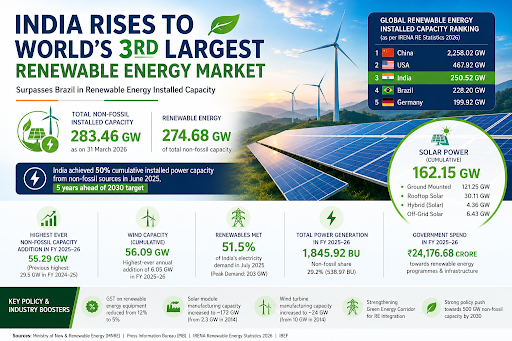
India has strengthened its position in the global clean energy transition by becoming the world’s 3rd-largest renewable energy market, with India’s Renewable Energy Capacity overtaking Brazil’s installed renewable energy capacity.
The latest Renewable Energy Statistics 2026 released by the International Renewable Energy Agency (IRENA) places India behind only China and the United States in the global Renewable Energy Ranking.
According to the Ministry of New and Renewable Energy (MNRE), India’s Renewable Energy Capacity reached 283.46 GW of non-fossil fuel installed capacity as of 31 June 2026, including 274.68 GW of renewable energy and 8.78 GW of nuclear power.
Union Minister for New and Renewable Energy Shri Pralhad Joshi said, “India ranks third globally in Renewable Energy Installed Capacity according to the Renewable Energy Statistics 2026. India has moved ahead of Brazil in the ranking.”
The country also recorded its highest-ever annual non-fossil capacity addition of 55.29 GW during FY 2025-26, almost double the previous record of 29.5 GW achieved in FY 2024-25. Solar energy remained the primary growth driver, with 44.61 GW added during the financial year, while wind energy recorded a record 6.05 GW in annual capacity additions across Renewable Energy in India.
India reached another major milestone in July 2025, when renewable energy met 51.5% of the country’s peak electricity demand of 203 GW, marking another achievement for Clean Energy India. During FY 2025-26, total electricity generation reached 1,845.92 billion units (BU), with 538.97 BU, or 29.2%, generated from non-fossil fuel sources.
Since the April announcement, India’s solar sector has continued to expand. According to the latest MNRE operational data for June 2026, cumulative installed solar capacity has increased to 288,589.39 MW (288.59 GW), with 162.15 GW of cumulative solar power capacity now operational.
The government continues to work towards achieving 500 GW of installed non-fossil electricity capacity by 2030, with Clean Energy India backed by large-scale investments in solar, wind, green hydrogen, battery storage, and transmission infrastructure.
Loading next article...
Our installation partners will check your requirements and send you quotations within 48h hours.
Your site visit will be scheduled at the provided location. The team will connect for a better experience.