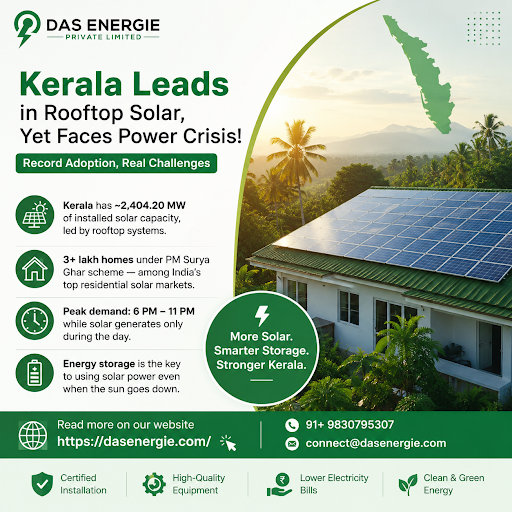
Kerala’s latest power shortage has exposed a growing challenge for rooftop solar. Despite ranking among India’s top states for residential solar adoption, the state continues to face evening power shortages because electricity demand peaks after sunset, when solar generation falls.
Electricity Minister Sunny Joseph said the duration of the crisis remains uncertain as electricity consumption has increased sharply while water levels in Kerala’s reservoirs have dropped to around 28% of capacity. The State has also sought approval to procure additional electricity through short-term contracts, even at higher costs, to bridge the supply gap.
Kerala has emerged as one of India’s strongest performers in solar power adoption. According to the latest official data, the state has around 2,404.20 MW of installed solar capacity, with rooftop installations contributing the majority. Under the PM Surya Ghar scheme alone, more than 3 lakh households have adopted rooftop systems, placing Kerala among the country’s leading residential solar markets.
Evening Peak Demand Limits the Benefits of Rooftop Solar
However, the state’s electricity consumption pattern presents a unique challenge. Around 75% of electricity consumers are domestic, causing demand to peak between 6 pm and 11 pm, long after solar panels stop generating electricity. Kerala State Electricity Board (KSEB) estimates that rooftop solar users consume only about 36% of the electricity generated during the day, while the remaining power is exported to the grid and later drawn back during evening hours.
Low Reservoir Levels and Grid Challenges Worsen the Power Crisis
The heavy daytime export of solar electricity also increases voltage across low-tension distribution networks, creating additional grid management challenges. At the same time, greater reliance on electric appliances during the evening has increased peak demand, forcing Kerala to purchase costly electricity from the national power market.
The State’s dependence on external electricity remains significant. Official data shows Kerala consumes around 88 million units of electricity daily, while domestic generation from hydropower, wind and solar contributes only a small share. Weak monsoon rainfall has further reduced hydropower availability, with reservoir storage falling to nearly 28%-29%.
Addressing the situation, Electricity Minister Sunny Joseph said, “It is not possible to say how long the power crisis will continue. Electricity consumption has increased significantly, while the water level in our reservoirs has dropped to just 28 per cent.” He added that the government is examining legal options to restore long-term power purchase agreements while arranging additional electricity through short-term procurement.
While Home Solar Systems continue to reduce daytime grid dependence, experts increasingly point to battery energy storage systems (BESS) as the missing link for improving grid stability and enabling greater use of Renewable Energy Kerala during evening peak hours. KSEB has already initiated battery storage projects, with the first large-scale facility expected to support better utilisation of surplus daytime solar generation.
Loading next article...
Our installation partners will check your requirements and send you quotations within 48h hours.
Your site visit will be scheduled at the provided location. The team will connect for a better experience.