The Rajasthan Rooftop Solar Scheme has received a major boost after the Central Government allocated 3 lakh residential rooftop solar systems to the state under the Utility-Led Aggregation (ULA/ULM) model of the PM Surya Ghar initiative. The allocation aims to accelerate clean energy adoption among low-income and vulnerable households while supporting India’s expanding distributed solar network.
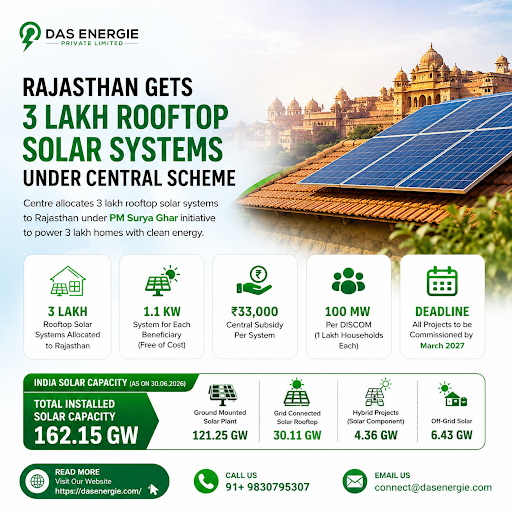
The announcement comes as India’s cumulative installed solar power capacity reached 162.15 GW as of 30 June 2026, according to the Ministry of New and Renewable Energy (MNRE). The country’s solar portfolio now includes 121.25 GW of ground-mounted solar, 30.11 GW of grid-connected rooftop solar, 4.36 GW from hybrid projects and 6.43 GW of off-grid solar installations.
Under the Rajasthan Rooftop Solar Scheme, each of the state’s three DISCOMs will install 100 MW of rooftop capacity, covering nearly 1 lakh households each. Every beneficiary will receive a 1.1 kW Residential Solar System free of cost.
The estimated installation cost has been fixed at Rs. 60,000 per system. The Centre will provide Rs. 33,000 as Central Financial Assistance, while the remaining Rs. 27,000 will be borne by the respective DISCOM, taking the total expenditure to nearly Rs. 600 crore for each utility.
The allocation supports the broader objectives of PM Surya Ghar, which seeks to expand rooftop solar adoption, lower household electricity bills and increase decentralised renewable energy generation. The programme also strengthens the availability of Solar Subsidy Rajasthan, particularly for economically weaker households eligible under the government-backed scheme.
Despite the large allocation, developers have expressed concerns over project economics. During a pre-bid meeting, industry participants said that rising prices of domestically manufactured solar modules, financing costs and mandatory bank guarantees have significantly increased the actual cost of execution.
Sunil Yadav, President of the Renewable Energy Association of Rajasthan, stated that the effective project cost exceeds the benchmark estimate once financing expenses are considered. He added that developers require at least a 10% operating margin for sustainable participation and also highlighted that tender package sizes ranging from 2,000 to over 15,000 households could discourage smaller vendors.
DISCOM officials have instructed successful bidders to complete installations within six months of the Letter of Award, with all projects required to be commissioned by March 2027. Delays beyond the prescribed timeline will attract a penalty of 1% of the deposited bank guarantee.
Industry stakeholders also believe faster subsidy disbursement, simplified approvals, quicker net-metering clearances and stronger coordination between implementing agencies and DISCOMs will improve execution.
Loading next article...
Our installation partners will check your requirements and send you quotations within 48h hours.
Your site visit will be scheduled at the provided location. The team will connect for a better experience.